RAIZ
Something is changing in Spain
Pablo Martínez, Elisa Urruela e Isabel Laviña
It’s becoming increasingly difficult to convince ourselves that we should settle for merely surviving. We can live better; we have the right to do so. And the only way to secure that future is by building collective power: organizing, fighting, and winning.
There are moments when a society seems to discover, almost suddenly, that what it had been enduring for years was not natural. That the hardships faced by millions of people have causes, those responsible, and, above all, alternatives. These moments are difficult to identify as they unfold, because they are often lost amid the noise of current events, fleeting outrage, or yet another protest.
But every now and then, something snaps. And what had seemed natural until then begins to feel intolerable. Perhaps we are going through one of those moments right now.
From Individual Injustice to Collective Struggle
Maricarmen’s story encapsulates many of the contradictions of our time. An 87-year-old woman, after seven decades living in her home, was evicted because her home had become a business opportunity. A lifetime of work and memories subordinated to the profitability expectations of a real estate investment. What is truly disturbing about her story is that it could have been just another eviction. Just another story lost among the thousands of people who are evicted from their homes every year.
But Maricarmen made a decision that would change the course of events. She decided to fight back, and she chose to do so by joining forces with the Madrid Tenants’ Union. She attended one of their assemblies, turned her problem into a shared struggle, and began to defend, alongside her fellow comrades, something that went far beyond her own home. The right of all people to build a dignified and stable home, regardless of whether they are homeowners or tenants.
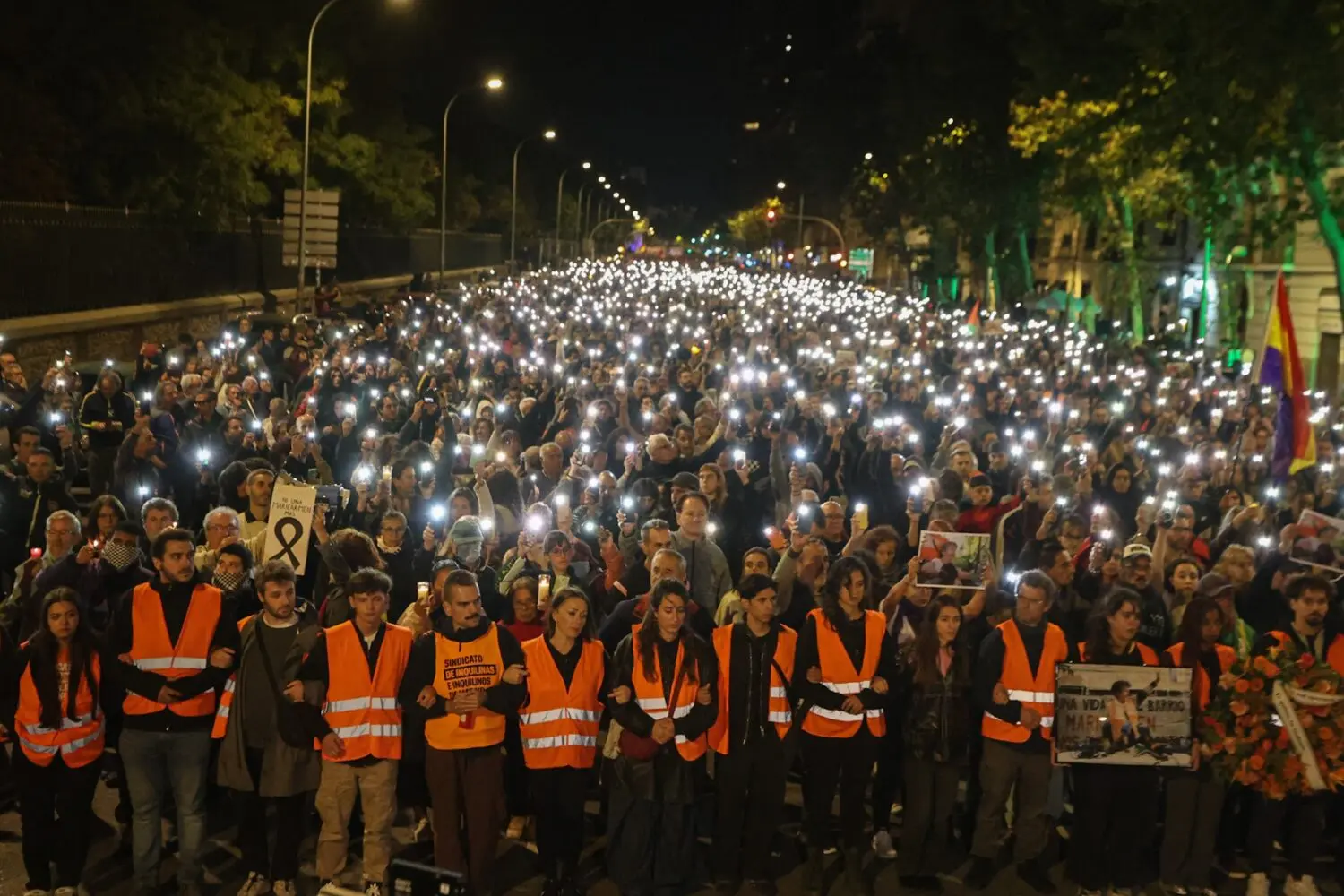
There is something deeply political about that decision. Maricarmen could have faced her situation alone, seeking an individual solution to a problem that seemed to be exclusively hers. Instead, she decided to organize. And it was precisely that decision that allowed her conflict to take on a dimension no one could have imagined. An elderly woman standing up to a real estate company ended up becoming the icon of a labor struggle capable of putting a fund on the ropes, toppling a government, and bringing a general strike, backed by every union in the country, to the forefront.
Her death has sparked a sadness and anger that are hard to describe. But it also forces us to ask ourselves what has happened to make her story shake an entire country in this way. The answer cannot be found solely in the outrage sparked by injustice. There have been years of union organizing, collective struggles, education, and the building of a social force that has been able to transform that outrage into a political struggle of extraordinary proportions.
Because the Madrid Tenants’ Union has demonstrated over the past few weeks something we had forgotten for far too long: that grassroots organizations can exercise power, set terms, wrest gains from those who seemed untouchable, and envision a future guided by different principles. The agreement reached with the landlord so that Maricarmen could regain her home, the legislative measures promoted in her name, and the mobilization of millions of people are all expressions of the same reality.
When there is organization, the balance of power shifts. And perhaps that is precisely where we begin to understand what is happening.
When Survival Is No Longer Enough
For decades, we have internalized a particularly cruel form of resignation. We have grown accustomed to the fact that working does not guarantee making ends meet, that becoming independent is a privilege, and that our aspirations must always conform to the needs of the market. We have learned to accept as personal problems the consequences of economic and political decisions that were never within our control.
Housing is probably the most obvious manifestation of this process. We have come to accept that an exorbitant portion of our wages goes toward paying rent to property owners, while our ability to build a life for ourselves is diminished. And we have done so under the promise that, with enough effort, we would one day manage to escape this situation, a promise that, for millions of people, has long since ceased to be credible.
However, something is changing in the way we interpret this reality. The unease sweeping through our cities is beginning to find collective explanations. It is becoming increasingly difficult to convince those who work, study, or care for others that their precarious situation is due exclusively to their personal choices. And when a society begins to recognize that what is happening to it has shared causes, it also begins to understand that it can confront it collectively.
This is one of the great achievements of the housing labor movement: having helped transform the way thousands of people understand their problems and, above all, the way they can solve them. The union’s assemblies have become spaces where individual helplessness finds collective answers. Where people who arrive convinced that nothing can be done discover that there are others facing similar situations and that, together, they can begin to change the rules of the game.
Organization as a Path to a Better Future
It is advisable, however, to avoid an overly triumphalist interpretation. Outrage does not guarantee any lasting change. History is full of outbursts that seemed to herald profound transformations but ultimately fizzled out without altering the structures that had caused them. The strength of the current moment will depend precisely on our ability to turn this mobilization into a stable organization, into new unions, greater membership, and a social force capable of sustaining struggles long after they disappear from the headlines.
That is why what is at stake goes far beyond housing. The difficulty of paying rent, the deterioration of public services, job insecurity, and the inability to have time to live are all part of the same struggle, that of a society in which the needs that sustain our existence are increasingly subordinated to the private accumulation of wealth.
And it is precisely at this point that we must broaden our aspirations. Because we have spent too much time discussing how to make a situation bearable that should seem unacceptable to us. Perhaps the time has come to return to a much simpler, and, at the same time, profoundly radical, question: Why should we settle for merely surviving when the necessary resources exist to live better?
The answer has political implications. It means understanding that rights are historical achievements, that no substantial improvement in the living conditions of the majority was a gift from those who held power, and that every advance required organization, conflict, and a collective will to transform the status quo.
The general strike for housing and against the high cost of living must open up precisely that horizon, the possibility that conflicts over wages, housing, care, or public services are recognized as part of the same struggle, because they are consequences of the same system. In these times, it is essential that the labor movement once again take center stage in the struggle over how wealth is distributed and who makes decisions about our lives. Because challenging how much we pay just to live is also challenging how much of our lives we are forced to give up so that others can continue to accumulate wealth.
Maricarmen is no longer with us. And no political victory can make up for that loss. But she leaves us something worth cherishing. Her decision to attend a union assembly reminds us that great changes often begin with seemingly small gestures. That organizing is a way to regain control over our lives, and that even those who seem most vulnerable can become agents of extraordinary change. Organizing around the central idea that we can live better, and with the certainty that in coming together we find a collective way of being in the world. That the Union is family, as our comrade said so many times.
Something has changed in Spain. Perhaps we cannot yet gauge its full extent, but one of the great certainties upon which our collective resignation had been built is beginning to crumble: the idea that life consists, fundamentally, of survival; that we should be grateful to have a job, even if it barely covers the cost of housing; that aspiring to anything more than just making ends meet is asking too much.
And when a society begins to break away from that idea, the horizon of what it considers possible also shifts. It begins to understand that a better life is a right worth fighting for. That we can aspire to have more time, better wages, decent housing, and an existence less plagued by fear of tomorrow.
But there is an even more important lesson in all that has happened. This shift in consciousness has found a way to organize itself. Maricarmen found in the Madrid Tenants’ Union the tool to defend her home and, alongside thousands of others, ended up sparking a much broader debate about the right to live with dignity. That is the power of unionism, and that is the political opportunity before us.
Because if anything has changed in Spain, it is that it is becoming increasingly difficult to convince us that we should settle for merely surviving. But it is also that we are beginning to remember something we should never have forgotten: that we can live better, that we have the right to do so, and that the only sure path to achieving that future lies in building the collective power necessary to make it a reality. Organize, fight, and win.